Who eats who? Predicting herbivores on non-native plants.
Submitted by drupaladmin on 11 July 2013.The introduction of non-native plants usually invokes a wave of pessimism among biologists. Some of these introduced plants can invade natural ecosystems where they can cause tremendous problems. And to make matters worse, it is very difficult to predict much about the ecological impact of a particular non-native plant prior to its introduction. We argue that one important consequence of a plant introduction is fairly predictable: which native herbivores are able to colonize it.
In the Early View Oikos paper "Predicting novel herbivore-plant interactions", Ian Pearse, David Harris, Richard Karban, and Andrew Sih argue that we can predict which native herbivores will successfully colonize which introduced plants if we understand some of the mechanisms of native herbivore plant interactions and the general properties of native food webs.
The basis for predicting novel associations between herbivores and plants is to define the "match" between an herbivore and its potential hosts. The logic behind this ends up being analogous to the way the Netflix movie website guessed (perhaps correctly) that I might like to watch "His Girl Friday" next (it is similar to another movie that I watched recently) or maybe an episode of "Downton Abbey" (a show that seems to be popular with many people right now). Indeed, the attempts to "match" us with a novel product (log in to Amazon) or person (visit match.com) are essentially pervasive to anyone who ventures onto the internet. This works because internet sites and companies collect a large (creepy?) amount of information about us and the products they sell.
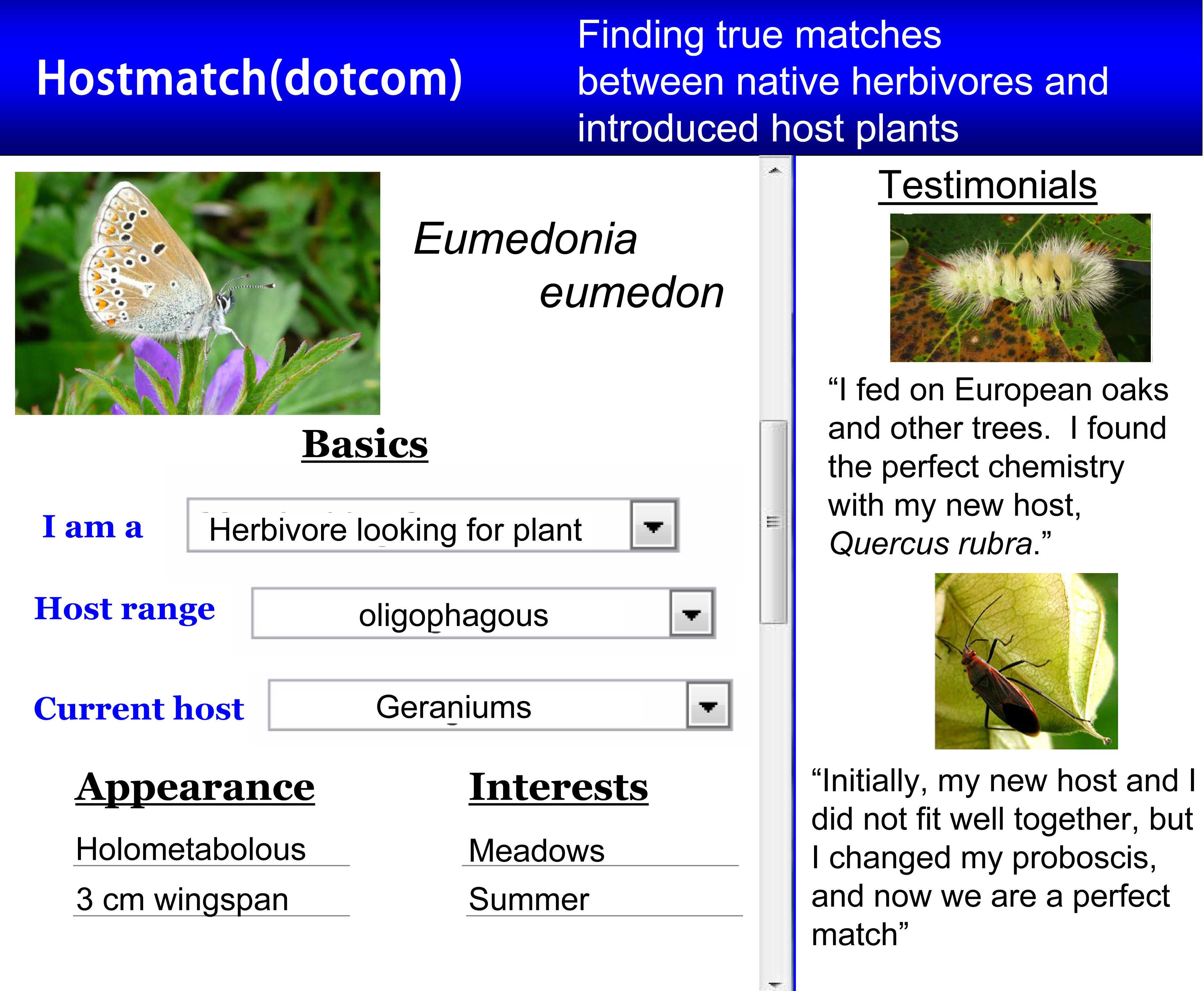
In the context of novel herbivore-plant associations, we already know many of the factors that drive these associations (phylogenetic constraint in host breadth, secondary metabolites, phenology, etc). And we have even begun to compile information about many native plant-herbivore food webs, which is perhaps akin to Netflix's list of movies that I and other costumers have watched. So, this paper suggests that (when armed with accurate native food webs and good lists of plant traits and evolutionary histories) we can start to make more accurate predictions about which native herbivores will colonize which non-native plants.
Of course, the natural history of individual organisms is complicated, and some interactions will be hard to predict. For example, the interaction between an herbivore and its novel host is an evolving relationship (see a recent Oikos review by Matt Forister dealing with this topic). But for many cases, herbivore interactions may be one of the most predictable elements of plant introductions.
Categories:
Insights into Oikos papers