What happens with coral reefs after anthropogenic disturbances?
Submitted by drupaladmin on 20 December 2012.What are the chances that the reefs recover? And how likely is it that they just turn into seeweed-dominated ecosystems instead? Important issues that Peter Mumby and his colleagues have studied and modelled in the new Early View paper "Evidence for and against the existence of alternate attractors on coral reefs".
Here's Peter's summary of the study:
Coral reefs have been heavily stressed by local anthropogenic disturbances, like fishing and pollution, as well as global events such as ENSO which can cause coral bleaching and wreak devastation on living coral. Ideally, corals would recover after some kind of disturbance but a number of studies have documented a lack of recovery and even continued decline of corals rather than return to a coral-rich 'attractor'. This raises the question, 'do coral reefs exhibit multiple attractors?'. If they do, then it is possible for negative feedbacks to emerge that not only prevent reef recovery but reinforce themselves and trap reefs within an undesirable state, often dominated by seaweed. If reefs do become trapped in an undesirable state it might prove extemely difficult for management to reverse the decline and facilitate the return of a healthy ecosystem.
Ecological models of coral reefs have studied the effects of various disturbances including the fishing of herbivores such as parrotfishes. Theory predicts that Caribbean coral reefs do indeed exhibit alternate attractors particularly in their somewhat degraded states today. However, empirical studies have claimed to find no evidence to support this theory. There is, therefore, a controversy over whether reefs can become trapped in seaweed-dominated systems. In this paper we argue first that the empirical studies were incapable of testing for multiple attractors. We then provide new comparisons between theoretical predictions and field observations, both of which are consistent with multiple attractors. However, it is also possible to fit a simpler model to empirical data that does not exhibit multiple attractors. When we take a careful look at this model we find that it makes several troubling ecological assumptions, which lead us to doubt its veracity.
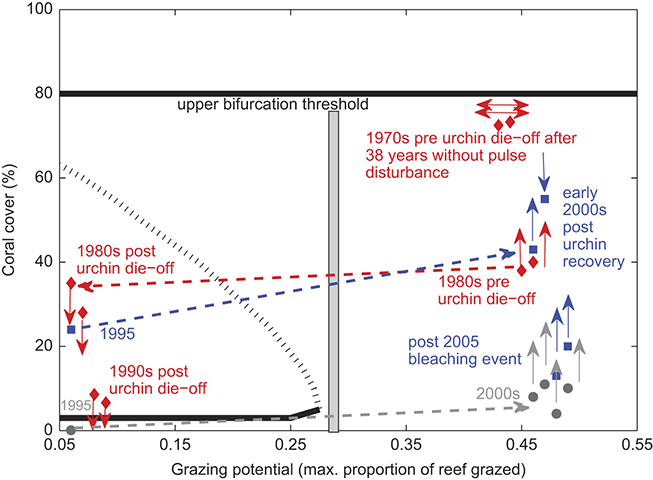
Proving the existence of multiple attractors is extremely challenging and there is, as yet, no definitive proof either way. However, the weight of theory and field observation appears to support the notion for Caribbean coral reefs. Given this, and it's important conservation implications, we feel that management should proceed on the conservative - and more likely - assumption that reefs can become stuck in seaweed states if stringent steps are not taken to increase their resilience.
Categories:
Insights into Oikos papers