TRANSLATING FOREST MANAGEMENT INTO KEY ENVIRONMENTAL CHANGES FOR DISPERSERS.
Submitted by editor on 21 March 2016.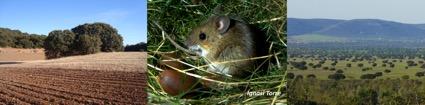 Get the paper!
We live in a world of changing landscapes, in which animals are forced to face new conditions of food and habitat availability, local competition for resources and predation risks. Plants that depend on these animals to disperse their seeds indirectly face the same challenges.

Modeling management effects on seed dispersal by animals is an attractive topic on ecological research. It will pave the way for detecting potential causes of seedling recruitment bottlenecks and for the development of more adequate management practices. However, in order to achieve these goals, we need to develop flexible models that translate forest management into changes in key environmental factors driving the behavior of dispersers. In other words, we need to integrate landscape with seed dispersal models.
We used such an integrated approach to model forest management effects on acorn dispersal by rodents. In highly managed holm oak forests acorn dispersal mostly depends on wood mice. However, oak-rodent mutualism is conditional. Depending on intraspecific competition for acorns and predation risks during mobilization, mice can act as net predators or local dispersers. In our model, forest management results in changes in both key environmental factors. Under these new conditions, mice modify their foraging decisions to safeguard acorn caches from pilferers but taking an acceptable amount of predation risks during mobilization. As a result, acorn dispersal services provided by mice change, but predictably, with forest management.
Thanks to our integrated approach we could predict acorn dispersal patterns in a wide range of management scenarios with few empirical variables (forest habitat loss, stem density and shrub cover). Besides, we could assess the behavioral mechanisms underlying forest management effects on acorn dispersal services provided by mice. It has been a great experience aiming at understanding plant population dynamics using models of animal behavior!
The authors through Teresa Moran-Lopez
Categories:
Insights into Oikos papers