Same, same but oh so different.
Submitted by drupaladmin on 16 April 2013.They look the same, but perform so differently. And act differently against each other. Cryptic amphipods are dealt with in the Early View paper "Phenotypically similar but ecologically distinct: differences in competitive ability and predation risk among amphipods" by Rickey D. Cothran and colleagues. Read their summary here:
Traditionally, species that look alike were thought to be unlikely co-inhabitants due to competitive exclusion. However, newer theory suggests that a mix of ecological similarity that limits performance asymmetries that lead to competitive exclusion and slight differences in niche use may maintain species diversity. We provide data on the relative competitive ability and predation risk for three amphipod species that co-occur in lakes in North America. Until recently, these species were only differentiated using molecular markers (see picture). We discovered that slight differences in phenotype lead to differences in how well these species compete and deal with predators. We also found that the two species that show the strongest overlap in distribution within lakes are very similar when it comes to their competitive ability and predation risk. Our work suggests that a mix of niche differentiation and ecological similarity are maintaining amphipod species diversity in lakes.
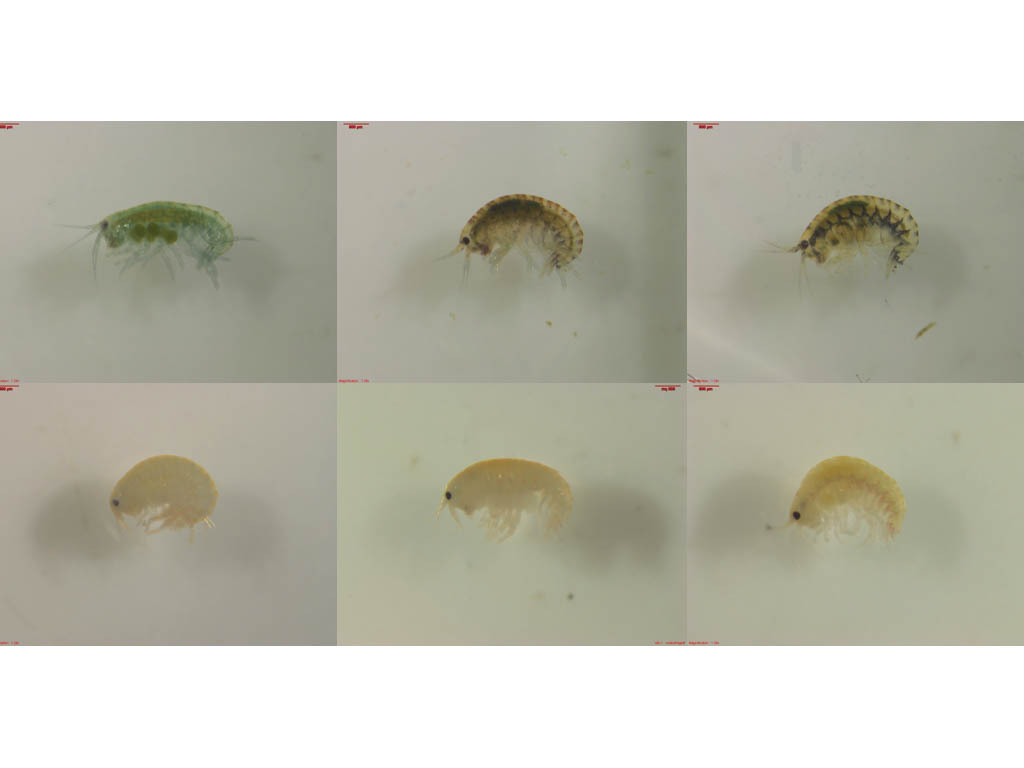 Cryptic amphipod species before (top) and after (bottom) preservation in 70% ethanol. From left to right: species A, species B, and species C. All animals are females.
 Picture caption: Cryptic amphipod species before (top) and after (bottom) preservation in 70% ethanol. From left to right: species A, species B, and species C. All animals are females.
Categories:
Insights into Oikos papers