On predation in the Bromeliad ecosystems
Submitted by editor on 13 October 2015.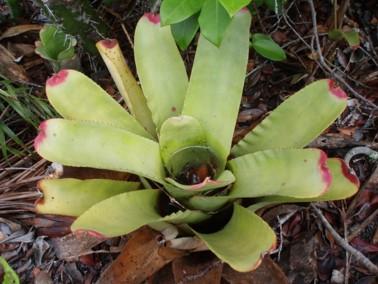 Get the paper!
Tank bromeliads are a family of Neotropical plants, with tightly overlapping leaves that are capable of accumulating rain water and detritus. These plants host a very diverse aquatic community in which the larval stage of several species of mosquitoes, non-biting midges, flies, and beetles may be found.

Research on bromeliad ecosystems has shown a strong and pervasive effect of the predatory damselfly larva on food web structure and bromeliad function (e.g., decreases in detritivore biomass and detrital breakdown, and increases in nitrogen uptake by the bromeliad). Recently, a study suggested that this effect may partially be caused by damselflies scaring their detritivorous prey. This effect was found when caged damselflies (which were unable to consume prey) were added to bromeliads. Similar research in other systems suggests that the detection of predators by prey (and, sometimes even their response) often relies on the use of predation cues, mostly by-products of prey consumption by predators. In the case of bromeliads, it was surprising that cues from a single prey genus could have such a large effect on this diverse ecosystem, suggesting that either all prey species are able to identify this cue, or that the damselfly itself is the main source of predation cues.
In our study, we were interested to know whether predation cues from damselfly larvae also (as in other systems) depend on the presence of by-products from prey consumption. We conducted a field experiment to investigate whether predation cues differed between fed and unfed caged damselflies, and whether the non-consumptive effect of the damselfly could cascade down to nutrient recycling. We found that the impact of the non-consumptive effect of the damselfly on the food web and ecosystem do not rely on prey consumption, and may occur even when the damselfly does not consume any prey. This was particularly important not only for a better understanding of the bromeliad ecosystem, but also to gain more insight into the impact of the non-consumptive effect of predators in natural ecosystems – as opposed to the laboratory settings most often used.
Categories:
Insights into Oikos papers