Is phenological asynchrony associated with climate?
Submitted by editor on 26 January 2016. Get the paper!
Trophic levels and species within them usually respond differently to global warming (Walther et al. 2002, Thackeray et al. 2010). This can lead to disruptions of many ecological interactions and, thus, different ecological processes may be altered, for instance the mutualistic interactions between plants and animals. Among the most conspicuous responses to climate change we find phenological shifts in biological events such as emergence, dispersal, migration, and reproduction. We now know that many species advance their phenologies, especially during the spring, others experience delays, and still others show no response to changes in climate(Peñuelas et al. 2013).
The ecological disruptions caused by the uncoupling (asynchrony) of interactions can have demographic consequences (Miller-Rushing et al. 2010, Kudo and Ida 2013) and it is thus important that we can predict them to be able to mitigate the effects, especially for species that are already threatened by other drivers of global change. One of the ecological functions that might be jeopardized by climate change is pollination by insects.
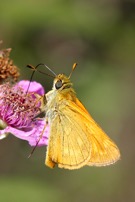
Ochlodes venata nectaring on Rubus ulmifolius Photo credit: J.M. Sesma
In our paper “Phenological asynchrony in plant–butterfly interactions associated with climate: a community-wide perspective” we aim at assessing the effects of climate change at the community level, not only on particular species as most studies have examined so far. By analyzing the flower-visitation interactions between 12 butterfly species and 17 plant species in the western Mediterranean coast in a 17-year period, we found that average asynchrony was higher in the spring butterfly generation and that dry conditions during winter lead to decreased temporal overlap with the flowers on which they feed in this butterfly generation. Moreover, dry conditions in the spring lead to higher uncoupling with the nectar resources in the summer butterfly generation. Although some plant-butterfly interactions showed to be more affected by climate than others, the magnitude of its effect was consistently small at the community level, indicating a buffering effect as predicted by the biodiversity insurance hypothesis (Loreau et al. 2001). In addition, and contrary to previous predictions of greater mutualistic disruptions in species with narrower niches, specialized-feeding butterfly species (those nectaring on only a few plant species) were found to be similarly vulnerable to asynchronies to generalized-feeding species. Our analyses further showed that, a least in the Mediterranean region, phenological asynchronies might be more affected by aridity level than by temperature itself, and thus the former can be a key climatic factor to make better predictions in this region.
Anna Traveset
References cited above:
Kudo, G. and Ida, T. Y. 2013. Early onset of spring increases the phenological mismatch between plants and pollinators. - Ecology 94:2311–2320.
Loreau, M.et al.2001.Biodiversity and ecosystem functioning: current knowledge and future challenges. - Science 294:804–808.
Miller-Rushing, A. J. et al. 2010. The effects of phenological mismatches on
demography. - Philos. Trans. R. Soc. Lond. B. Biol. Sci. 365: 3177–3186.
Peñuelas, J. et al. 2013. Evidence of current impact of climate change on life: a walk from genes to the biosphere. - Global Change Biol. 19: 2303–2338.
Thackeray, S. J. et al. 2010. Trophic level asynchrony in rates of phenological change for marine, freshwater and terrestrial environments.- Global Change Biol. 16:3304– 3313.
Walther, G.R. et al. 2002. Ecological responses to recent climate change. - Nature 416:389–395.
Categories:
Insights into Oikos papers