Motifs in the assembly of food web networks.
Submitted by editor on 25 August 2015.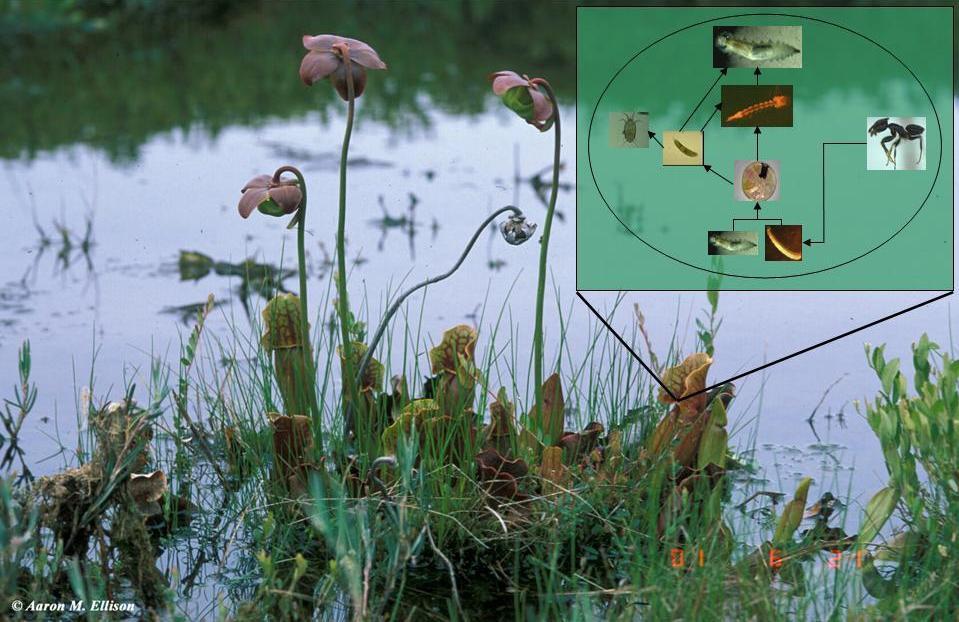 Get the paper!
Traditionally, the role of species interactions in community assembly is inferred from patterns of taxonomic, functional, and phylogenetic diversity. Furthermore, assembly theory employs a competition-based framework that does not include trophic interactions or the assembly of entire food webs. Network motifs, subgraphs of nodes and edges that occur more often than expected compared to random network topology, provide a framework for directly studying the assembly of trophic interactions and thus entire food webs.
We used three-node motifs to explore the assembly of food web networks that inhabit the northern pitcher plant, Sarracenia purpurea, across two scales; from the continental scale to the site scale and from the site scale to the local scale. We specifically asked if motif structure in a given network matches the motif structure in the network it was assembled from.
We found that food webs generally had the same patterns of motif structure as the food web networks from which they were assembled from the continental network to site networks and from site networks to local pitcher networks. This suggests that the same processes are structuring the S. purpurea food web across spatial scales.
Benjamin Baiser, Rasha Elhesha and Tamer Kahveci
Categories:
Insights into Oikos papers