Monsterciliates as pac-man predators
Submitted by drupaladmin on 2 January 2014.A sheep increasing 4 times in size, starting to eat competing rabbits! Wow, that would be something! And it's almost true, at least in the ciliate world! Find out more in the new Early View paper "Trait-mediated apparent competition in an intraguild predator–prey system" by Aabir Banerji and Peter J. Morin. Here's their short version of the paper:
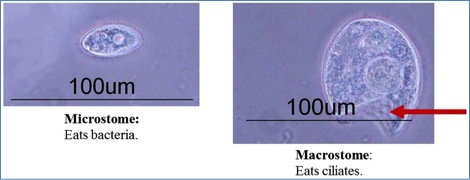
This investigation stemmed from our earlier work on the inducible trophic polymorphism (ITP) of Tetrahymena vorax. In the presence of competing ciliates, individuals of T. vorax (starting as small, pear-shaped bacterivores) can completely reconstruct their cytoskeletons and increase their size to up to four times what it was before, becoming spherical predators capable of rapidly phagocytizing their competitors. This transformation occurs within six hours and is completely reversible. In the figure below, the red arrow points to the cytopharynx (“mouth”) of the predatory morph.
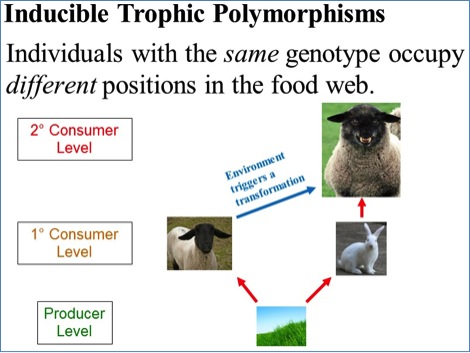
Though there are several real-life ITPs among macroscopic taxa that are roughly analogous to that of T. vorax, I find the fictional example shown below to be slightly more accurate (and fun to present).
While attempting to see which prey we could rear T. vorax on of the ones we had in-stock at our lab, we noticed that T. vorax seemed to get bigger when fed bigger prey. This is a pattern that has been observed in various other ciliate predators (and a few macroscopic predators), as well. I was dying to call it “chasmatectasis” (from the Greek words for “gape” and “stretching”) – a term inspired by the way one of my friends in the medical profession had described the phenomenon of competitive eating: “self-induced gastrectasis.” (Luckily, my labmates talked me out of coining lame phrases at this point.)
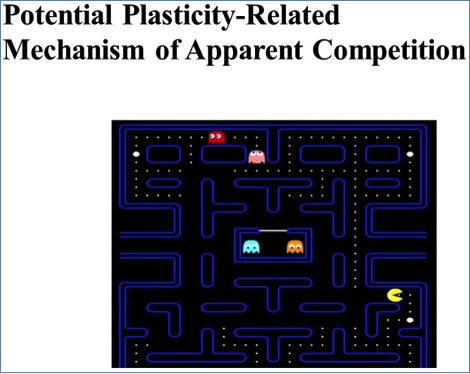
What we really wanted to know was whether this phenomenon could give rise to a novel form of apparent competition (one that was trait-mediated, rather than density-mediated). Conceptually, this would be like what happens in the Pac-Man video game – eating large prey items allows the predator to eat things it normally would not be able to eat.
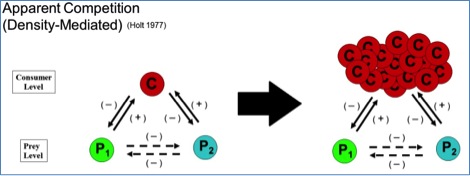

As it turns out, it can.
Categories:
Insights into Oikos papers