How do mutualists avoid extinciton?
Submitted by editor on 8 September 2015.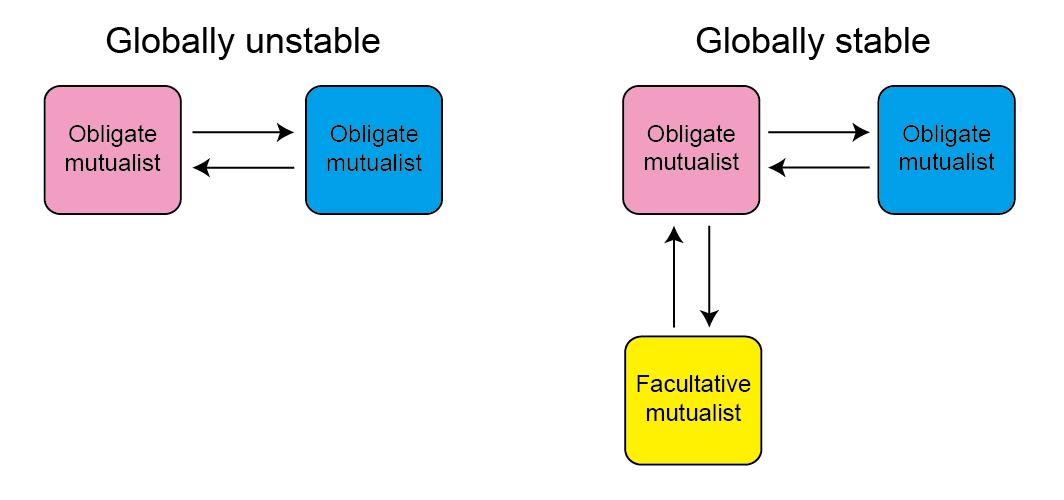 Get the paper!
Mutualism is a form of species interactions in which each species gains benefits from each other. An obligate mutualist is a species whose survival and/or reproduction requires the benefits from its partners, and a facultative mutualist does not necessarily require the benefits from its partner for its survival and reproduction. In nature, we often see mutualism between obligate species, such as yuccas and yucca moths, figs and fig wasps, myrmecophytes and ants, lichens and mycorrhizae, and others. However, existing mathematical models of obligate mutualism predict that, theoretically, a pairwise relationship between obligate mutualists is fragile; both mutualists will inevitably be driven into co-extinction if either species is perturbed to low densities.

How do we reconcile this discrepancy? One possible answer may come from the field observation that, in some cases of obligate mutualism, one of the obligate mutualists is oligolectic (i.e., with a few mutualistic partners) and can interact with a third facultative mutualist. For example, a yucca plant associated with its obligate yucca moth pollinator can also be pollinated by flies in locations where its legitimate pollinators are scarce. We developed a mathematical model of a pairwise mutualism of two obligate species with one species interacting with another facultative mutualist. This model predicts that the interaction with the facultative species can make the obligate mutualism highly stable and resilient, so that their global co-extinction can be avoided even upon a large disturbance. This result may not only resolve the theoretical instability of obligate mutualisms, but also be important for the conservation of mutualistic networks.
The authors through Gaku Takimoto
Categories:
Insights into Oikos papers