June Cover
Submitted by editor on 12 June 2015. Get the paper!
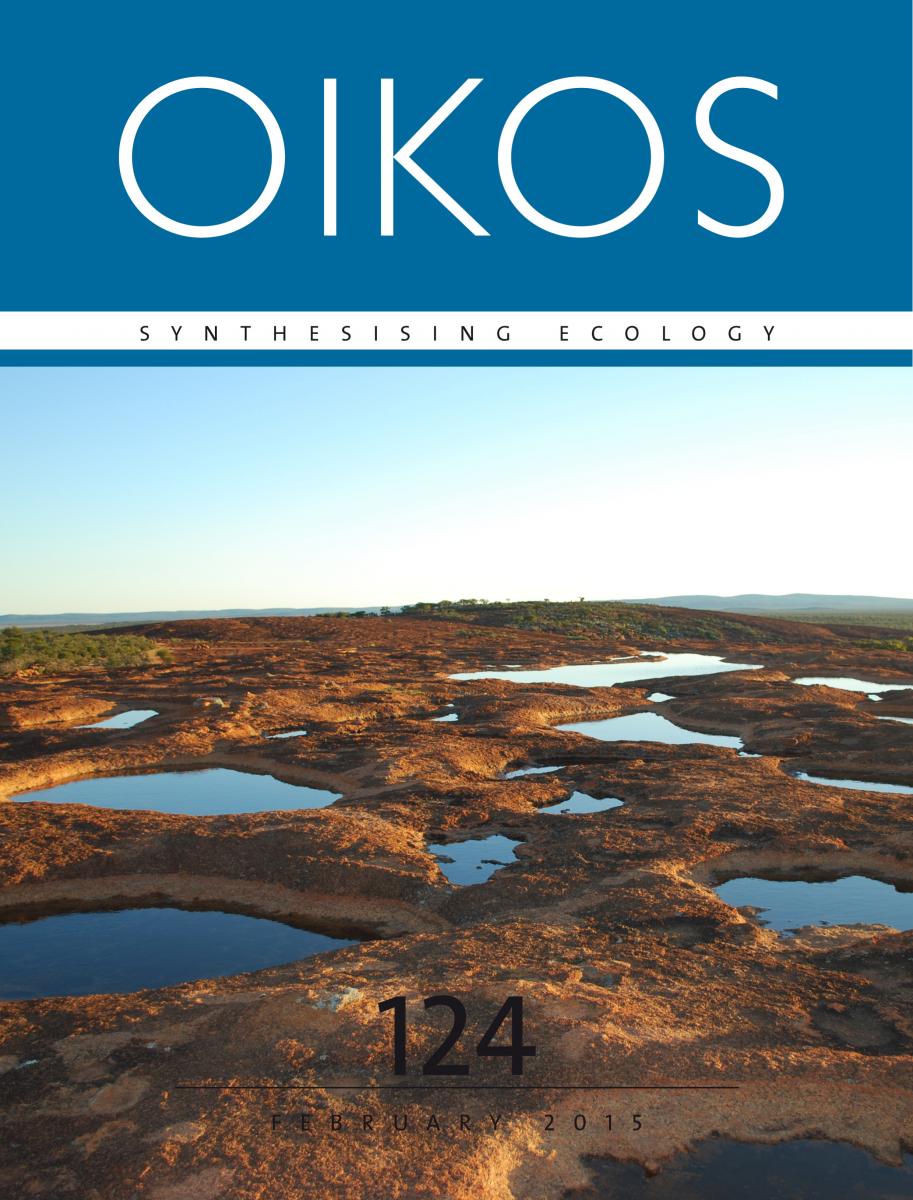 The photo at Oikos' June cover is taken by Bram Vanschoenwinkel, one of the authors to the paper "Hydrological stability drives both local and regional diversity patterns in rock pool metacommunities" in the same issue. Here he describes the photo and the study:
The picture shows a cluster of temporary rock pools at the summit of a granite outcrop in the outback of Western Australia. The original aboriginal name of the outcrop is Walga Rock. Such outcrops typically contain eroded depressions that, after rains, transform into archipelagos of temporary rock pools. The first human inhabitants of Australia used these outcrops for shelter and often relied on the deeper rock pools as a source of freshwater. In fact, rock paintings have been found that show maps of important rock pool sites in the surrounding landscapes from which water could be gathered. Certain outcrops such as the famous sandstone Uluru (Ayer's Rock) in the center of Australia are also considered sacred sites.
The rock pools themselves typically house many specialized invertebrate taxa that survive dry periods via dormant life stages in the sediment. Frogs use them as reproduction sites and so do many aquatic insects that fly in during the rainy season from distant sources of permanent water.


Two pictures show typical rock pool inhabitants: the first is a male of the spectacular (blue) fairy shrimp Branchinella longirostris which uses a long proboscis to catch females. As a result we call it the harpoon fairy shrimp. The second is a tadpole shrimp: a new undescribed species of Triops found exclusively in the rock pools in the picture. These crustaceans look like horseshoecrabs but the similarity is the result of convergent evolution. They are formidable predators that catch and grind their prey using spiny teeth attached at the base of the legs. The last picture shows two of my students on the slope of Walga rock climbing up to the summit where the pools are located. In the background you can see the vast expanse of mulga trees characteristic of the dry inland areas of Western Australia.
First pioneer work on rock pools in Australia was performed by Ian Bayly and later by Brian Timms, who collected the original data for this paper together with Merlijn Jocqué and Luc Brendonck. Brian Timms is a taxonomist and ecologist who has spend several decades travelling through Australia to sample and describe the fauna of inland water bodies. Luc Brendonck's main interest is the adaptations of organisms to pond drying and diapause in particular. He also was the PhD promoter of Merlijn Jocqué and Bram Vanschoenwinkel. Merlijn Jocqué's interests include the ecology, biogeography and taxonomy of freshwater invertebrates. His current pet model systems are bromeliad metacommunities in Honduras. Karen Tuytens is a PhD student working on hydrological models for temporary ponds and she ran the simulations for this paper. Bram Vanschoenwinkel wrote the paper and his research group is coordinating the work on Australian rock pools as spatially hiercharchical models to study metacommunity processes in the field at the interface of community ecology and biogeography (more info www.insularecology.com). This study was just a pilot project as recently assembled datasets include more than 600 sampled rock pools over 60 inselbergs.
In the study published in this issue of Oikos an exploratory analysis was performed to look at the importance of hydrological disturbance as a dominant driver of diversity patterns both within pool clusters as well as between pool clusters along a latitudinal gradient. We report that hydrological stability can not only explain local differences but also regional differences in diversity and species composition. More frequent droughts and shorter hydroperiods seem to limit community membership both at local and regional scales. The current results do not suggest that regional processes and dispersal among outcrops are important in explaining current diversity patterns at this scale. This is not surprising since mountains have been colonised by freshwater invertebrates at least several million years ago (Pinceel et al., 2013) and contemporary gene flow among mountains seems to be very limited. Instead, the long history of the habitat in combination with efficient local within cluster dispersal (Vanschoenwinkel et al., 2008) could explain why a strong link between species composition and stability is found both within metacommunities, as well as among metacommunities along a sub-continental climate gradient.
Such muti-scale studies contribute to the emerging conceptual synthesis between community ecology and biogeography which aims to describe both common and unique processes that explain diversity patterns at different scales.
Pinceel, T., Brendonck, L., Larmuseau, M. H. D., Vanhove, M. P. M., Timms, B. V. & Vanschoenwinkel, B. 2013. Environmental change as a driver of diversification in temporary aquatic habitats - does the genetic structure of extant fairy shrimp populations reflect historic aridification? Freshwater Biology 8: 1556-1572.
Vanschoenwinkel, B., Gielen, S., Vandewaerde, H., Seaman, M. & Brendonck, L. 2008. Relative importance of different dispersal vectors for small aquatic invertebrates in a rock pool metacommunity. Ecography 31: 567-577.
Categories:
General