Welcome new SE - Yngvild Vindenes
Submitted by editor on 10 November 2015.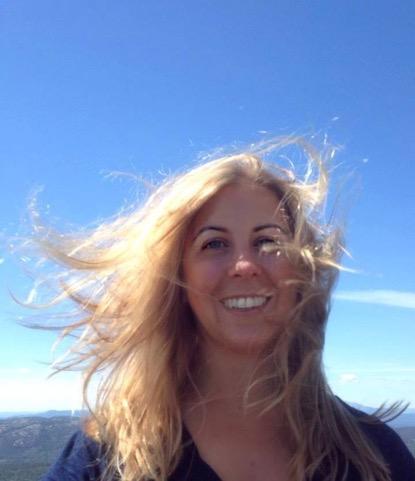
We're very happy to welcome Dr Yngvild Vindenes, Oslo, Norway, to our Editorial Board. Get to know her in the mini-interview below! And visit her webpage here.
What's you main research focus at the moment?
I use demographic approaches (such as matrix models and integral projection models) to disentangle biological responses to climate change, from the level of individuals to populations, and up to communities. I am also interested in how individual variation in life histories arises and affects eco-evolutionary dynamics. My main study systems in recent years have been two fish populations, pike (Esox lucius) from Windermere, U. K., and brown trout (Salmo trutta) from Mjøsa, Norway. In collaboration with several colleagues I have developed and analysed size-structured population models for these populations to look at consequences of external impacts such as climate change and harvesting. More recently I have started a project to evaluate impacts of changing climate variability (short-term fluctuations), where we will also do some Daphnia experiments. In general, I like the combination of theoretical development and empirical applications and always try to include both in my research.
Can you describe your research career?
I did my PhD at NTNU in Trondheim, Norway, under supervision of Steinar Engen and Bernt-Erik Sæther, and I graduated in December 2010. My PhD research focused on the consequences of individual differences for stochastic popualtion dynamics, and included theoretical studies as well as an empirical study on Oystercatchers (in collaboration with Martijn van de Pol). After my PhD I joined the Centre for Ecological and Evolutionary Synthesis (CEES) in Oslo, Norway, where I am still working as a researcher. During my time at CEES I have led two research projects, one on effects of climate change in size-structured populations and another just started on effects of changing climate variability. Both projects include collaboration with several good colleagues, at CEES and elsewhere, and I am also involved with other projects. I have also continued my PhD research on effects of individual differences, but mostly these days I work with biological responses to climate change.
How come that you became a scientist in ecology?
I have always been interested in nature and wildlife, and in particular I have always been fascinated by the vast diversity of life histories that have arised across the tree of life. Later I became interested in how this variation is reflected in population dynamics and biological responses to external impacts such as climate change. Throughout my studies I also enjoyed learning mathematics and dynamic modeling, and since these are very important aspects in the field of ecology it was a natural choice to me to become an ecologist.
What do you do when you're not working?
Besides spending time with family and friends, I like to run, hike, play floorball, go crosscountry skiing or mushroom picking. I also like to knit, read, cook, and watch tv series.,
Categories:
General