On the usefulness of boring presentations
Submitted by editor on 31 July 2015.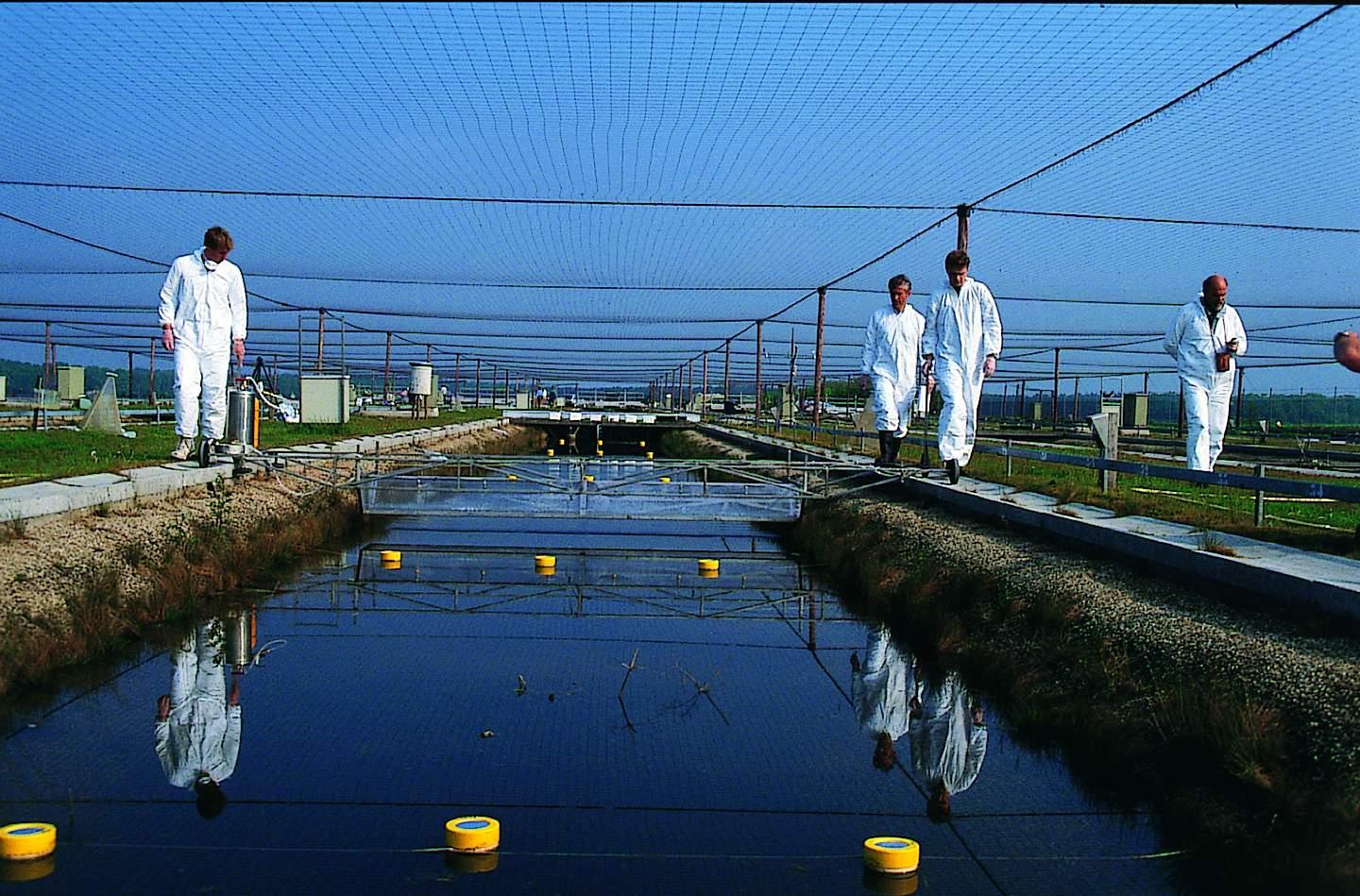 Get the paper!
Old data + new techniques = new answers to old questions:
On the usefulness of boring presentations
Most biodiversity-ecosystem functioning experiments focus at one trophic level and use randomly assembled communities. However, in natural systems communities are rarely assembled randomly, moreover, the negative effects on biodiversity at one trophic level can propagate to affect ecosystem functions carried out by other levels.
Complex food webs, many species, response to non-random removal of species? Such data exist, even if they were collected for a different purpose. While trying to listen to a not too exciting presentation, one of the co-authors, Volker Grimm, observed his neighbour, another co-author, Paul van den Brink, doing impressively fast Excel jiggling of data from mesocosm experiments he and others had carried out almost 20 years ago (see the photo of experimental settings). The purpose of those experiments was to quantify recovery of freshwater ditch communities after a pulse disturbance by an insecticide.
We used these data to test how biodiversity affects ecosystem functioning in case of non-random biodiversity loss caused by insecticide application. Specifically, we wanted to assess how changes in consumer biodiversity affect the ecosystem function delivered by primary producers (gross primary production). We looked not only at the mean of ecosystem functioning, but also at its temporal standard deviation, thus assessing the impacts on stability properties as well. To this ends we employed a method recently suggested by Gross et al. (2014).
We found that insecticide reduced and destabilized consumer diversity, especially of macroinvertebrates. However, this affected neither mean nor standard deviation of the gross primary production. The reason for such absence of effects on ecosystem functioning was that the species most sensitive to insecticide application were different from the species that affected ecosystem functioning the most. Particularly, dominant species were those most susceptible to insecticide, whereas much less abundant species strongly affected ecosystem functioning. This study emphasizes the importance of assessing the relation between effect and response functional traits, as this will shed light on the mechanisms underlying the relationship between biodiversity loss and ecosystem functioning.
I, the leading author of the study, enjoyed this project very much. First, it demonstrates that one can learn a great deal from the lots of data that are already accumulated in ecology, before investing money and effort in the design and collection of new data (see also another analysis of these data by a further co-author, Frederik De Laender[1]). Second, this is a nice example of how an idea that appeared during a workshop can grow up into a post-doc project, conducted by a collaborative effort of a group of people. And these people I would like very much to thank for this nice experience: Frederik de Laender, Paul van den Brink and Volker Grimm.
Viktoriia Radchuk
[1] F. De Laender, C.J. Melian, R. Bindler, P.J. Van den Brink, M. Daam, H. Roussel, J. Juselius, D. Verschuren, C.R. Janssen. The contribution of intra- and interspecific tolerance variability to biodiversity changes along toxicity gradients. 2014. Ecology Letters, 17, 72-81
Categories:
Insights into Oikos papers