Sweet and tasty: how salinity can increase attraction
Submitted by editor on 31 August 2015.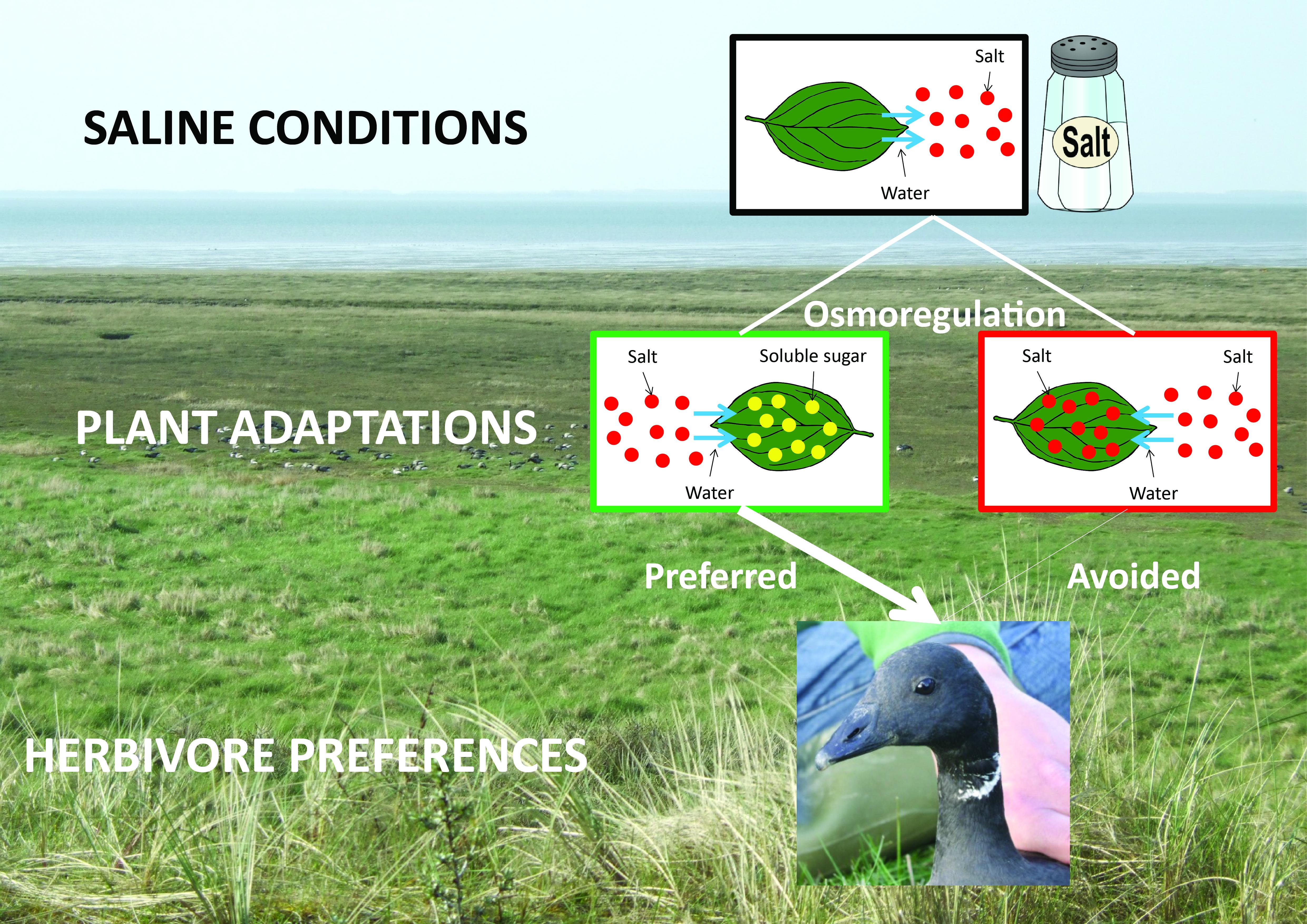 Get the paper!
In our study system (a salt marsh on a back-barrier island in the Wadden Sea) it is very obvious: some plants are highly preferred by herbivores and are being grazed down to the ground, whereas others are not being grazed at all. One of the main herbivores during early spring, the migratory brent goose, has been shown to have clear preference for specific species. What makes these plant species so super-palatable? Classically, this would be explained in terms of high nitrogen content and large proportions of digestible biomass. However, there might be another explanation. All plants growing on a salt marsh are adapted to saline conditions. One of the main problems of growing under high salinity is losing water because of the high osmotic potential of the environment. There are many different ways to adapt to this. We focus on plants which balance their internal osmotic potential with the outside environment by storing soluble sugars or compartmentalized (in anions and cations) salts. Consumers under saline conditions have been shown to avoid the most saline food resources. So the plants using compartmentalized salts would expected to not be fed upon by the herbivores. Sugars on other hand can provide extra energy and plants which use soluble sugars as an osmoregulatory adaptation could be selected by herbivores.
We tested this hypothesis for our study system and after collecting plant material and brent goose droppings in the field during early spring, followed by many chemical analyses in the lab, our study shows that brent geese indeed avoid plants with high salt contents. On the other hand brent geese strongly prefer sweet plants which store soluble sugars to cope with salinity, whereas the classic parameters do not explain why some species are preferred over others. Therefore our study points towards osmoregulatory adaptations as an important, but overlooked explanation for super-palatability in plants, which could also be important in other systems with extreme conditions (e.g. drought or cold).
Figure: overview of our results. Plants under saline conditions loose water due to the high osmotic potential of the environment. Hence, plants are adapted, in this case with either salts or soluble sugars. These adaptations on their turn are an important explanation for whether a plant is preferred or avoided by brent geese. On the background: the salt marsh ecosystem in which these results were collected.
The authors through Wimke Fokkema
Categories:
Insights into Oikos papers