Stoichiometrically imbalanced diets
Submitted by editor on 15 September 2015.Get the paper!Leaf-consuming detritivores feed and grow on some of the poorest quality resources available in nature: dead organic matter of mostly terrestrial origin that has a high proportion of carbon (C) relative to other essential elements such as nitrogen (N) and phosphorus (P). Despite the constraints imposed on consumers by this nutritionally imbalanced diet, as formalized within the framework of ecological stoichiometry, detritivores thrive by exploiting this resource, thereby acting as important decomposers of plant litter. How do detritivores manage to grow in these conditions and what are the repercussions for plant litter decomposition as an important ecosystem process when the ratio between C, N and P is unbalanced between consumers and their diet?
We found that both consumer growth and consumer-mediated litter decomposition were affected by the degree of stoichiometric imbalance between detritivores and leaf litter. However, responses of growth and decomposition differed. Whereas growth was higher on a stoichiometrically more balanced diet, decomposition was generally stimulated by a more balanced diet if a second resource (i.e. a second leaf species) that was stoichiometrically less balanced was offered simultaneously. This result suggests that preferential rather than compensatory feeding drives detritivore-mediated decomposition of stoichiometrically imbalanced litter.
Interestingly, despite the relatively low N:P ratios of our detritivores, indicating potential P limitation, their growth actually appeared to be limited by N rather than P in three phylogenetically and stoichiometrically distinct species. High N requirements for chitin and silk production by invertebrates could drive much of the unexpected N limitation we observed. These N-rich compounds are constantly lost during invertebrate development, as invertebrates repeatedly moult during growth, and the caddisfly species we examined spins N-rich silk to build its case. Thus, although P is a critically important nutrient because of its high content in ribosomal RNA required for protein synthesis and hence growth, a shortage of N appears to be key in constraining growth of invertebrates that constantly lose N-rich compounds during their development.
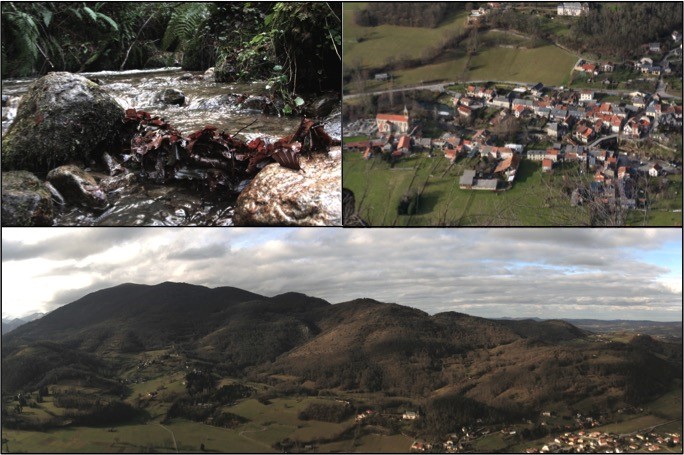
Clock-wise starting on the top left panel: (1) Rémillassé stream, where the experimental chambers were placed, with natural accumulation of leaf litter behind boulders during autumn. (2) The village of Moulis where the laboratorial facilities were located and (3) a panoramic photo showing Moulis and the foothills of the French Pyrenees..
The authors through André Frainer
Categories:
Insights into Oikos papers