Herbivory, competition and global warming
Submitted by editor on 22 April 2014.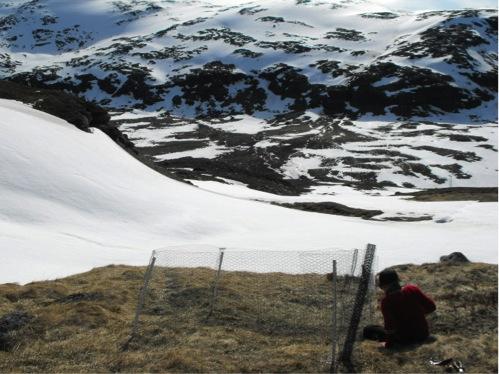
How altered temperature might affect competition and herbivory in plant communities is studied in the early View paper "Concurrent biotic interactions influence plant performance at their altitudinal distribution margins" by Elina Kaarlejärvi and Johan Olsson. below is their summary of the paper:
The idea behind this paper was to test whether herbivory and competition influence growth and reproduction of lowland and tundra forbs at different altitudes. Previous studies had indicated that these biotic interactions could play a role in determining species altitudinal distributions, but this has been rarely experimentally tested.
We studied this in subarctic Abisko, in northern Sweden, on meadow habitats at two altitudes, at 600 and 900 m a.s.l. We selected five study sites at the two altitudes, each of them consisting of a pair of plots: one plot was fenced against large mammalian herbivores, while another was left open. Nested within this herbivore exclusion treatment we carried out biomass removal treatment to investigate effect of plant-plant interactions. We planted seedlings of lowland and tundra species to both altitudes and followed their growth and reproduction over two growing seasons.
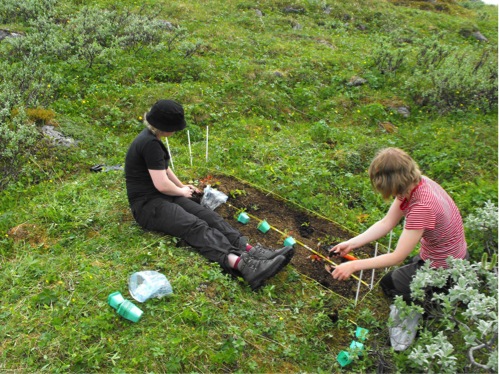
Studying plant-plant interactions. Planting seedlings of lowland and tundra forbs to a subplot without neighboring vegetation at a low altitude site.
We had expected to find competition at low altitudes and facilitation at high altitudes, but found that competition prevailed in both altitudes. However, high-altitude tundra forbs suffered more from competition; neighbor removal increased the proportion of flowering individuals and tended to increase growth of one of the high-altitude species more at low altitudes. Since the low altitude sites were about 2°C warmer (summer air temperatures) than high altitude sites, these results suggest that climate warming may strengthen competition and potentially shift lower distribution margins of high-altitude forbs upward. Interestingly, mammalian herbivores may counteract these climate-driven distribution shifts, as they reduced the growth of lowland forbs and enhanced the flowering of tundra forbs.
Categories:
Insights into Oikos papers