Editor's choice January
Submitted by drupaladmin on 21 January 2013.From January 2013 our Editor's in Chief select two papers in each issue as Editor's Choice. Those papers are Open Access, and the complete January Issue is OA! Here, Dries Bonte explains why they chose the following for the January issue. Read more here about News in Oikos 2013.
 The following papers ‘Pattern Detection in Null Model Analysis’ (Werner Ulrich and Nicholas J. Gotelli) and ‘How does the invasive/native nature of species influence tadpoles' plastic responses to predators’ (Eudald Pujol-Buxó, Olatz San Sebastián, Núria Garriga and Gustavo A. Llorente)were selected as the first editor’s choice papers for 2013.
We selected these papers for two different reasons, thereby demonstrating the different pathways by which ecologists can create synthesis in their own field of expertise. The work by Pujol-Buxó considered the importance of phenotypic plasticity in both functional morphology and behaviour in a set of invasive and native prey and predators. The work brings synthesis by merging concepts of behavioural ecology, developmental plasticity and invasion ecology and provides a mechanistic understanding of invasions in a well selected set of species (interactions). It is true that the ecological impacts of invasions are becoming well understood, often in the sense of impact on population and species dynamics of native species. However, since all changes in ecology should ultimately result in altered selection pressures and back, more effort is needed to understand eco-evolutionary dynamics of species invasions, both in the invasive and native species. This field becomes nowadays overwhelmed with theory and empirical work is clearly lagging behind, so contributions like this are essential as critical tests of the developed theory.
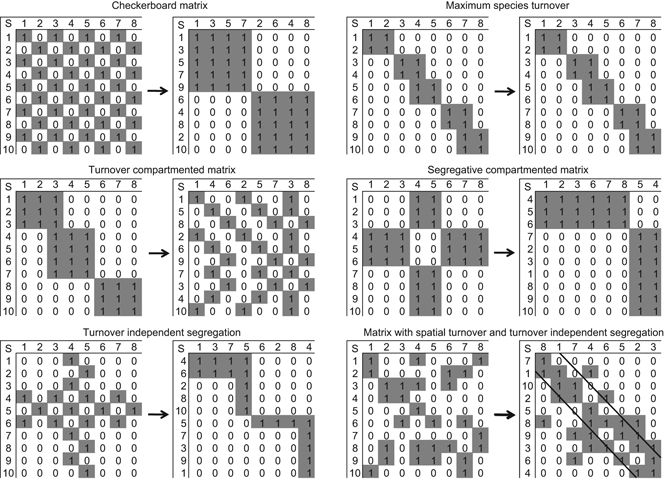
The second contributions Ulrich and Gotelli emphasises on the proper use of different metrics to identify distinctive patterns in species x site presence-absence matrices. These approaches are important for understanding metacommunity organisation. Because the behaviour of different metrics is often correlated, it proved to be difficult to distinguish different patterns. Therefore, Ulrich & Gotelli created synthesis by testing the performance of a suite of null models and metrics that have been proposed to measure patterns of segregation, aggregation, nestedness, coherence, and species turnover. While there is no need to provide more detail here, they concluded that sources of non-randomness are best assessed by using different combinations of metrics. As such the paper is a natural and logic continuation of their previously published and highly valued consumer’s guide to nestedness analysis. We are sure that this contribution will receive the same attention and use in future community ecology.
Categories:
Announcements and eventsInsights into Oikos papers