Diversity, diggers, and disease: nutrient balance and ecosystem function in grasslands
Submitted by drupaladmin on 4 November 2013.How herbivores and nutrient interact in grassland communities is studied in the early View paper "Multiple nutrients and herbivores interact to govern diversity, productivity, composition, and infection in a successional grassland" by Elizabeth T. Borer and co-workers. Here's Elizabeth's summary of the paper:
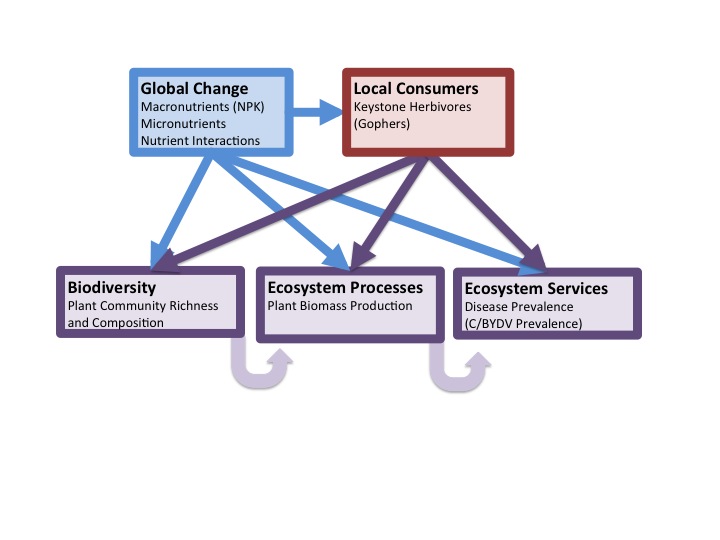
We have all heard about the health benefits of a balanced diet, and it turns out that nutritional balance matters in ecosystems, too. While most research examining nutrient effects on ecosystems has focused on one or two nutrients, such as nitrogen and phosphorus, humans are concurrently changing the supply rates and ratios of many different nutrients, creating the possibility for complex effects on ecosystems and the services they provide. We found that the ratio of nitrogen to phosphorus supplied to a grassland ecosystem had larger impacts on infection by a common crop disease than any single major nutrient alone. Grassland net production increased with nitrogen fertilization, but consumption of plants by a common grassland herbivore, the pocket gopher, caused net grassland production to decline with fertilization. Single factor studies would not have uncovered these and other relationships even though such relationships are critical for effective predictions of biodiversity and ecosystem functioning in a world in which human activities are simultaneously changing herbivore abundance and the relative supply of many growth-limiting nutrients.

Categories:
Announcements and eventsInsights into Oikos papers