Amur tigers: how they choose where and what to eat
Submitted by editor on 22 May 2015. Get the paper!
We know that the distributions of carnivore populations across the globe depend heavily upon where prey species are available. Prey availability depends not only on prey density but also on prey accessibility which is affected, in part, by the configuration of landscape attributes that make prey vulnerable to predation. However, exactly how spatial variation in these processes shape patterns of carnivore habitat use at the home range scale remains poorly understood, particularly for solitary carnivores such as the Amur tiger. In our paper, “Spatial variation in the density and vulnerability of preferred prey in the landscape shape patterns of Amur tiger habitat use,” we examined the influence of prey density and prey landscape vulnerability on patterns of Amur tiger habitat use within the home range. We mapped density and vulnerability separately for 3 primary prey species (red deer, wild boar, and sika deer) across 20 consecutive winters in Far East Russia to evaluate this research objective.
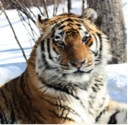
An Amur tiger (Panthera tigris altaica) in Far East Russia
We discovered that Amur tigers tended to organize their habitat use within the home ranges in response to specific prey species, rather than aggregate density and vulnerability maps for all prey species. Our results show that red deer and wild boar were preferred prey species of Amur tigers accounting for 72% (201 of the 278) of all kills detected. These results emphasize the importance of evaluating predation dynamics at the level of individual prey species rather than in aggregate forms. We also found that Amur tigers tended to center their home ranges on habitat where red deer were most vulnerable to predation, but would use habitat where red deer were dense in the peripheral regions of their home ranges. This suggests that tigers may utilize two separate strategies for acquiring prey. Further research into Amur tiger microhabitat selection is ongoing to elucidate such relationships. As the configuration of resource patches within the home range influences carnivore survival and reproduction, our analysis has implications for tiger conservation that extend beyond our improved understanding of tiger-prey ecology.
An Amur tiger (Panthera tigris altaica) drinking in Far East Russia
Categories:
Insights into Oikos papers